They didn’t whisper it.
They said it out loud. Online. In comment sections that never forget and rarely forgive.
Words like plain. Aging. Why her?
At first, it sounded like the usual noise—people projecting opinions onto a woman they don’t know, tied to a man they idolize. Nothing new there.
But then the photos resurfaced.
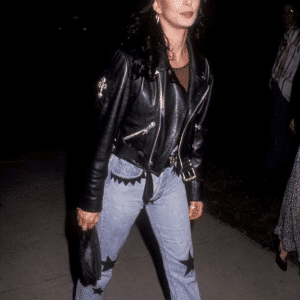
Old ones. The kind you don’t pose for. The kind taken before anyone thought the internet would have an opinion.
And suddenly, the conversation shifted.
For years, critics have fixated on one thing. Not her work. Not her voice. Not the life she built.
Her hair.
Silver. Unapologetic. Untouched by dye. Enough to spark endless theories about age, health, and choices that were never anyone else’s to make.
People assumed they knew the story.
They didn’t.
Because the truth is, the gray didn’t arrive late in life. It showed up early. Much earlier than most people expect. In her twenties, according to her own words.
Imagine standing in front of that mirror for the first time.
Noticing strands that don’t match the rest. Realizing this isn’t a phase or a bad week. Knowing a decision is coming—cover it, or live with it.
Most people don’t hesitate. They reach for the box. The salon appointment. The fix.
She didn’t.
And that choice—quiet, personal, unbothered—ended up defining how the world would later see her.
Or judge her.
Fast forward to red carpets and flashes. To standing beside one of the most recognizable men on the planet. To being photographed from every angle, frozen in moments that invite commentary.
That’s when the comparisons began.
Why does she look older?
Why doesn’t she try harder?
Why doesn’t she dye it?
Questions stacked on top of each other, rarely asked with curiosity. Mostly with cruelty.
But here’s where things get interesting.
The archival photos.
Before the silver became her signature. Before strangers decided they knew her age by looking at her hair.
In those images, she looks different—not transformed, not unrecognizable—but softer. Youthful. Bright-eyed. The kind of beauty that doesn’t perform for the camera.
And that’s when people started backtracking.
Because suddenly, the narrative of the “ugly duckling” didn’t hold up.
The woman in those photos wasn’t hiding anything. She wasn’t trying to prove something. She was simply existing—artist first, appearance second.
That’s the part many missed.
Long before the relationship became public, she had already built a reputation on her own terms. As a visual artist. A thinker. Someone who lives in ideas, not mirrors.
And yes, now the names come into focus.
Alexandra Grant.
And the man beside her? Keanu Reeves.
Their ages? Nearly the same. Barely a gap at all. Yet somehow, she’s the one scrutinized as if time touched her differently.
Maybe because she didn’t try to erase it.
Fans who’ve followed him for years weren’t surprised by his choice. Many said it made sense. That he’s never been drawn to surface-level glamour. That he’s always valued depth over dazzle.
They talk about conversations. Shared projects. A quiet rhythm that doesn’t beg for attention.
That context matters.
Because when you look at those old photos again—really look—you realize the gray hair never took anything away.
It added something.
It stripped the illusion that women owe the world youth forever. That love must come wrapped in conventional packaging.
The irony is hard to miss.
The very thing people mocked her for is what makes her stand out. What makes her real in a sea of sameness.
And now, as those early images circulate, there’s a strange satisfaction in watching critics go quiet.
Not because anyone “won.”
But because assumptions were exposed.
It turns out the story was never about aging badly.
It was about aging honestly.
There’s a difference.
Scroll through the photos and you can feel it. The continuity. The same person, just in different chapters.
No reinvention. No apology.
Just time doing what time does.
And maybe that’s why the conversation still isn’t finished.
Because once you see it—once you understand the choice—it changes how you look at her.
And maybe how you look at everyone else, too.
Especially the ones who never asked to be judged in the first place.