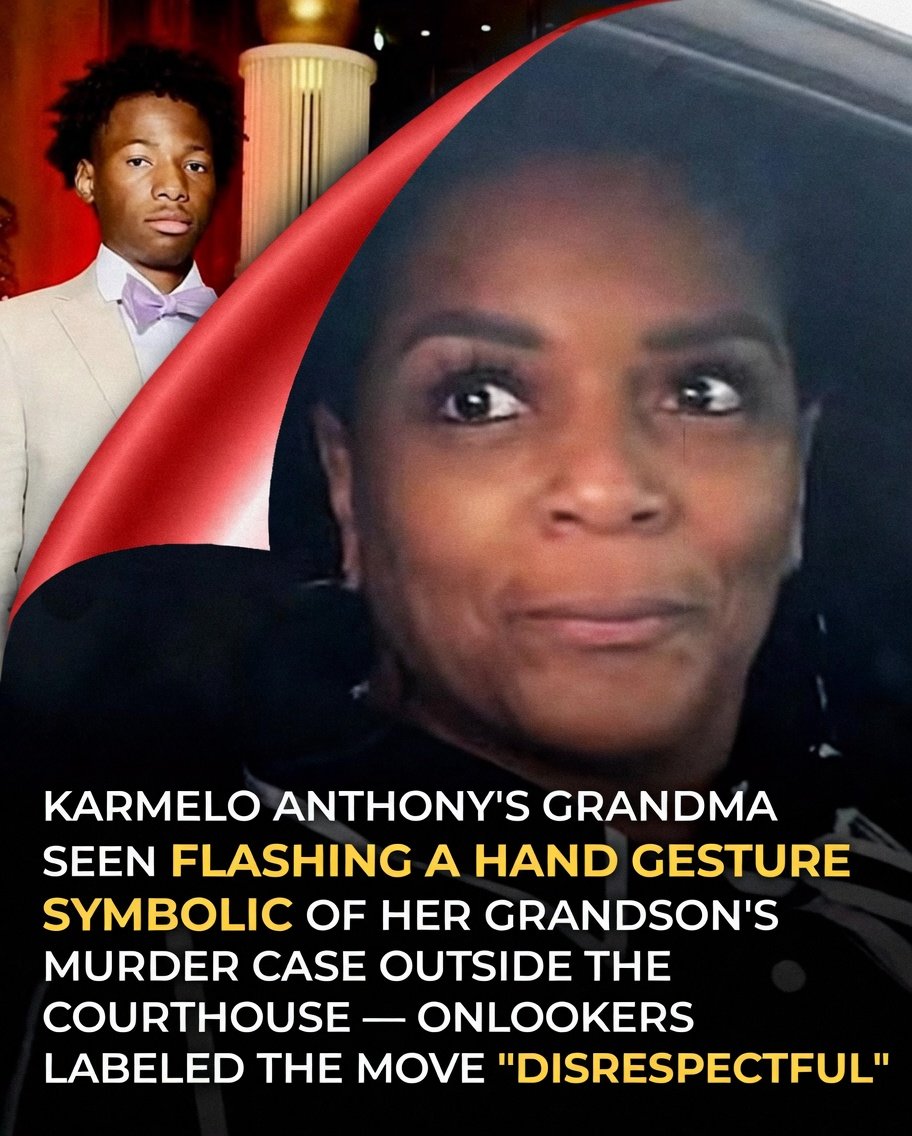
A grandmother’s actions outside a Texas courthouse are drawing serious attention following a high-profile murder conviction that has captivated the entire nation.
On June 10, 2026, 19-year-old Karmelo Anthony was found guilty of killing fellow teenager Austin Metcalf and handed a lengthy prison sentence in McKinney, Texas, located in the Dallas suburbs.
His grandmother, Toni Hayes, was caught on camera leaving the courthouse shortly after the ruling, and what she did on her way out has become the moment nobody can stop discussing.
Hayes was filmed riding in the passenger seat of a black Acura sedan as it pulled away from the building, surrounded by a crowd of predominantly Black supporters who had shown up ahead of the verdict.
She leaned toward the window and shouted ‘Racist! Bias!’ at those gathered outside, words that seemed to mirror what portions of the crowd were already chanting aloud.
Anthony’s family moved swiftly after the verdict to characterize the conviction as racially motivated. Supporters outside were calling for his release, with chants of ‘Free Karmelo’ rising from the crowd.
Hayes appeared to feed off the surrounding energy. And then came the hand gestures.
As the vehicle moved through the crowd, she formed a heart symbol with her fingers directed at the supporters outside. In any other setting, it might have come across as a warm, affectionate gesture.
In this context, arriving just hours after her grandson was sentenced to prison for murder, many viewers interpreted it very differently. The videos spread rapidly, and people online did not hold back their opinions.
Comments were divided between those stunned by Hayes’s apparent calm and those zeroing in specifically on the heart gesture, given the nature of Metcalf’s death.
On YouTube, one person wrote, ‘I find them showing a hand gesture of a heart repulsive and disrespectful. Considering the young boy killed was stabbed in the heart… 😢’
Another commenter was far more blunt, writing, ‘The fact this so called grandmother is smiling and making hearts instead of balling her eyes out after her grandson was sentenced to 35 years in prison is absurd! HOW RIDICULOUS!!!!’
A third viewer directed their question straight at Hayes: ‘Is that heart your making a symbol of where your grandson stuck a knife and murdered someone [sic]?’
Others were simply puzzled by the gesture. ‘What is up with all the lame heart gestures?’ one person asked.
Some viewers watching the footage believed Hayes’s gesture looked like something else entirely.
On Instagram, commenters were blunt. ‘Was she throwing gang sign at the end 😂,’ one person wrote. Another added, ‘Throwing gang signs while driving, tells me everything I need to know.’
Throwing gang signs, also called ‘flashing’ or ‘stacking,’ involves using hands and fingers to form specific shapes, letters, or symbols linked to a street gang. It is a practice with deep roots in gang culture.
Whether Hayes was flashing gang signs or simply expressing gratitude toward the crowd remains up for debate. But the footage captured from that car window, filmed in the charged moments after her grandson’s sentencing, has taken on a life of its own.
And Anthony’s guilty verdict brought all kinds of different reactions. As previously reported, he reportedly remained expressionless as it was read. He was then escorted out of the courtroom. But others in attendance reacted very differently.
NBC DFW reporter Maria Guerrero noted that Anthony’s family members and supporters became emotional as the verdict was announced. His mother, Kala Hayes, was seen weeping from the gallery.
Meanwhile, Austin’s twin brother, Hunter Metcalf, leaned forward in his seat as jurors delivered the guilty finding against Anthony. But although the verdict had been reached, one major question still loomed: how long Anthony would actually spend behind bars.
The proceedings then moved into the sentencing phase, where both sides focused on determining Anthony’s punishment. Under Texas law, a murder conviction carries a sentence anywhere from 5 years to 99 years in prison. During this phase, the defense argued that the killing happened under the immediate influence of ‘sudden passion.’
Prosecutors previously explained that sudden passion refers to a situation where someone becomes so consumed by emotion from a just-occurred event that they have no time to calm down. If jurors accepted this argument, the punishment range could be significantly reduced.
As the legal fight shifted toward sentencing, Anthony’s mother became one of the defense’s final witnesses.
Before taking the stand, she was offered water and tissues by defense attorney Mike Howard, according to an NBC DFW courtroom report. When she began speaking about her son, her emotions surfaced almost immediately.
‘He’s my oldest,’ Hayes told the jury. ‘He’ll always be my baby. I love him very much.’ She then broke down in tears. When asked whether Anthony felt remorse for what happened, she gave a clear response.
‘Yes, I know my son, and he’s very sorry for what he did,’ Hayes said. As her testimony wrapped up, she made one last appeal to the jurors. ‘Please have mercy on my son,’ she said. The defense rested shortly after.
As the sentencing proceedings moved forward, one of the most powerful moments of the day came during the victim impact statements. The fourth person to address the courtroom was Austin’s twin brother, Hunter. Before speaking about his brother’s death, Hunter made a direct request to Anthony.
According to courtroom reporting, Anthony had been looking down throughout the victim impact statements. Hunter asked him to lift his head, show respect, and meet his gaze. Anthony then looked up. Hunter told the courtroom that he had spent the past year trying to make sense of why his brother’s life was taken and working toward forgiveness through his faith.
‘You took a son, a brother, a friend, and my best friend, from this world,’ the grieving brother said through tears. ‘You took someone from me who was supposed to be an uncle, godfather to my kids. Now I want everything taken from you.’
Hunter said his mother cries herself to sleep each night and that he wakes up every single day knowing he can no longer speak to his twin. After concluding his statement, he stepped down from the stand and was embraced by friends. The Metcalf family then walked out of the courtroom.
As the jury began deliberating Anthony’s punishment, tension inside the courtroom continued to mount. Hours later, jurors returned at approximately 7:30 p.m. with their decision. But before they entered the room, another moment drew eyes.
According to a separate NBC DFW report, Anthony was sitting with his head down in the moments before the jury came back. He appeared to be sobbing and was being comforted by a female attorney on his defense team.
The scene was a sharp contrast to the blank, emotionless reaction observers had described when the original guilty verdict was announced earlier in the day.
When the jury returned, Judge John Roach asked Anthony to stand. Defense attorney Mike Howard placed a hand on his shoulder as everyone in the courtroom waited.
The judge then announced that jurors had rejected the defense’s sudden passion argument. Anthony was sentenced to 35 years in state prison.
He will be required to serve at minimum half of that sentence before he becomes eligible for parole. Shortly after, the judge ordered Anthony to be taken into custody and removed from the courtroom.
Following the sentencing, one witness shared what she said she personally observed. During a television interview, the witness said:
‘When they gave that man the verdict, he broke down, and he cried. He broke down, and he cried […] When they came back with the verdict, he broke down, and he cried.’
She added, ‘That boy’s not good […] That boy broke down and cried. They done [expletive] the rest of this boy’s life.’
The witness also claimed that Hayes became emotional as the decision was delivered. ‘She was sitting there with him. She thought she would be okay, but she broke down and cried,’ the witness said. Describing the mood inside the courtroom, she called it ‘somber.’
When asked about her own reaction, she responded, ‘Why do we have to care anymore? Why are we even here? To be honest, why are we here? What are we here for?’
She continued, ‘What do you want us to do? What do you want us to do at this point? What? I’m lost for words.’
As coverage of the case kept rolling after sentencing, a newly released mugshot of Anthony quickly circulated across social media. The image triggered a flood of reactions from online commenters. ‘He doesn’t look to [sic] upset,’ one person wrote. ‘He don’t look scared now, and he’s not crying [sic],’ another added.
A third wrote, ‘He’s always had dead eyes…a troubled young man.’ Similar reactions appeared across other platforms. ‘Still the same look of no remorse, dead eyes and all,’ one commenter wrote. Another asked, ‘What happened to the curly hair?’ ‘I wonder why he cut his hair for the trial,’ a third person commented.
While the trial has now reached its conclusion, the deeply emotional scenes that unfolded in its final hours highlighted the lasting toll this case has taken on everyone involved.
From Hayes’s tearful plea for leniency to Hunter Metcalf’s gut-wrenching victim impact statement, the sentencing hearing offered a raw window into the grief, regret, and devastation that continued to fill the courtroom long after the guilty verdict had been delivered.
With Anthony now beginning a 35-year prison sentence and Austin Metcalf’s loved ones continuing to grieve their loss, the case may be legally closed, but its impact is likely to be felt for many years ahead.