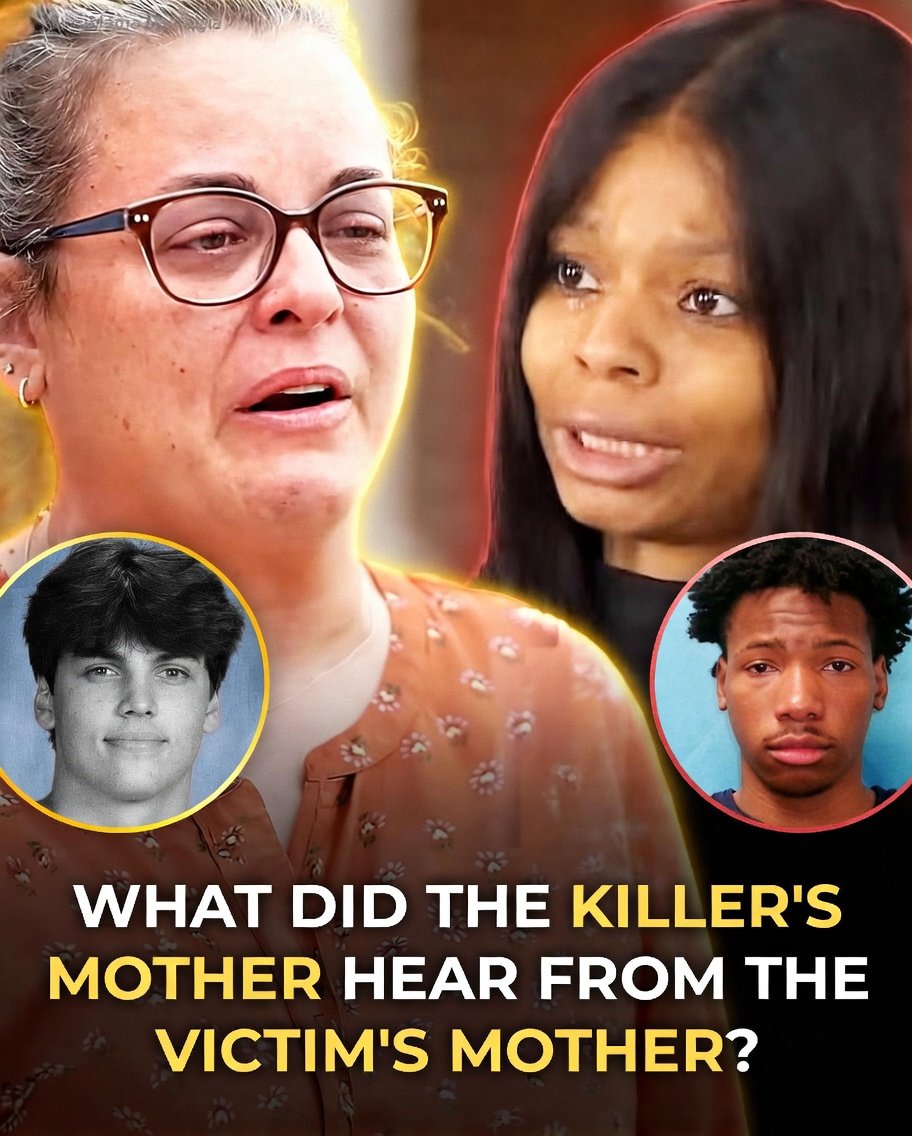
A grinning child captured in family snapshots — a mugshot taken inside a Texas county jail. Between those two images lie 19 years and one deadly choice at a high school track meet.
On June 9, 2026, a Collin County jury convicted Karmelo Anthony of murder and handed him a 35-year prison sentence for the fatal stabbing of 17-year-old Austin Metcalf.
The verdict brought a case that had held the nation’s attention for over a year to a close — but for both families, nothing about that moment felt like closure. On one side of the courtroom, one mother had hoped to walk her son out the door.
On the other side, another mother told the boy who took her son’s life that no matter how many years he served, she was carrying the longer sentence. Both mothers were grieving, but Kayla Hayes’ son was still breathing, and Meghan Metcalf’s was not.
The events leading up to the sentencing started on April 2, 2025, at Kuykendall Stadium in Frisco, Texas, during a high school track-and-field event. A rain delay forced athletes and spectators to seek whatever shelter was available.
Karmelo Anthony, then 17 and attending a rival school, sat under a tent that wasn’t his. The Memorial High School track team had claimed that space, and the unwritten rules of a high school meet are simple: you stay under your own team’s shelter.
Twins Hunter and Austin Metcalf, along with others, asked him several times to move. He refused. What unfolded in the moments that followed is what the jury would examine again and again.
The argument escalated until Karmelo warned Austin, ‘Touch me and see what happens,’ with one hand concealed inside his backpack. When Austin shoved him, Karmelo drew a knife and stabbed him once in the chest. Austin did not survive the wound.
Jury selection got underway on June 1, 2026. When deliberations began, jurors dismissed Karmelo’s self-defense claim after hearing testimony from more than 20 witnesses — the majority of them students who had been there that day.
The state agreed to let jurors weigh ‘sudden passion,’ a legal standard that, if accepted, would have reduced the potential sentence to somewhere between two and 20 years.
The defense contended that Karmelo had been overcome by intense emotion and acted before he had a chance to think clearly. The jury rejected that argument as well.
After roughly two hours and 20 minutes of deliberation, the jury returned with a 35-year sentence. Karmelo must serve at least half of that time before he can be considered for parole.
Karmelo did not take the stand during the punishment phase. When he was brought back into the courtroom for sentencing, he was visibly crying with his head lowered.
The defense called just one witness during the sentencing phase: Karmelo’s mother, Kayla Hayes. Breaking down in tears before the jury, she pleaded for mercy.
‘Please have mercy on my son,’ she said. ‘He’s my oldest. He’ll always be my baby. I love him very much.’ She told the jury she knows who her son really is — and that his remorse is genuine.
‘I know my son, and he’s very sorry for what he did.’ During cross-examination, prosecutors asked Kayla if she still loved her son. She said yes.
They then asked whether she understood that, no matter the outcome, he would still be in her life. She said yes to that as well. Kayla was confronting a particular kind of emptiness. Her son was alive.
Her son was sorry, she had told the jury. Her son was heading somewhere she couldn’t follow for the next three and a half decades. That was the version of motherhood the verdict had left her.
When Meghan Metcalf stood to deliver her victim impact statement, the courtroom went still. She described a home now transformed beyond recognition — mornings without her son, a bedroom he would never walk back into.
‘Going into an empty room, empty bed, and once again remembering Austin is dead.’ She spoke about conversations that can no longer happen the way they once did.
‘Now my conversations with him are one-sided, sitting at his grave. … I have to accept that instead of walking beside me, he’s walking above me.’
Meghan remembered Austin as a ‘morning kid’ and a ‘hugger’ who ‘always had a way of bringing people together.’ She called him a peacemaker. ‘Austin’s laughter would fill the room.’
She also spoke about Austin’s twin brother. Hunter walked out of that courtroom into a life he was supposed to live alongside someone who was no longer there.
‘Seeing my twin lose the most important person in his life crushes his mother,’ Meghan said. Of the home they once all shared, she added: ‘From the moment my boys were born, they were my world. Now my house is quiet.’
Her words to Karmelo were measured — and devastating. ‘You should feel lucky, because I’ve been sentenced to a lifetime without my son.’ She made one thing unmistakably clear before she sat down. ‘My son was murdered. He didn’t just die.’
The photos spreading across the internet tell a story the courtroom only partially revealed. Early images show Karmelo as a young boy — birthday gatherings, school days, the ordinary milestones of a childhood that looked, from the outside, like any other.
Later photos show a teenager: self-assured, smiling. The kind of pictures any parent stores on their phone. And then there is the booking photo taken at the Collin County jail on June 9, 2026.
Austin had his own collection of images. It ended on April 2, 2025. There will be no graduation photo. No college portrait, no wedding picture, no baby held up to a camera — none of the moments Meghan had expected to add to her phone over the years ahead.
The photos she has of her son are the only ones she will ever have. Austin’s album stops at 17. He would not grow older. His mother was now speaking to a grave. Karmelo would be in his mid-50s when he walked free. Austin would still be 17.
Thirty-five years. Not the maximum. Not the minimum. A number that landed somewhere between Kayla’s plea and the grave holding Meghan’s son, and satisfied neither.
Thirty-five years is a long stretch of time. It is also, by Meghan’s reckoning, less than what had been placed on her the instant her son stopped breathing in the stands at Kuykendall Stadium.
Karmelo Anthony was transferred to the Texas Department of Criminal Justice on June 10, 2026, after completing the agency’s intake process.
Two mothers. Two forms of grief. One courtroom, and a sentence that closed a case without closing anything at all.