They thought it would be one of those days.
The kind you replay later while unpacking bags, laughing about wrong turns and snack stops. Nothing special. Just together.
No one wakes up thinking this is the day everything changes.
The plans were simple. A drive. A destination everyone agreed on. Time away from schedules and screens.
That quiet excitement filled the car early that morning — the soft kind, where no one’s rushing yet.
Windows cracked. Music low. Conversations drifting.
Those moments feel ordinary while they’re happening. Almost invisible.
Until they aren’t.
The road was familiar. Not dangerous. Not dramatic. Just another stretch of pavement they’d driven before.
That’s part of what makes it so hard to understand afterward.
Nothing warned them.
No sudden argument. No risky decision. No obvious mistake.
Just movement. Forward. Like always.
The weather had shifted without much notice. A thin layer of moisture on the road. Visibility slightly off. The kind of conditions people deal with every day.
Most of the time, nothing happens.
This time, something did.
It didn’t unfold slowly.
It never does.
One second everything felt normal — the hum of tires, the rhythm of the drive.
The next second wasn’t anything like that.
Control slipped.
Not dramatically. Not violently at first.
Just enough.
And that was all it took.
Later, people would talk about how quickly it happened. How there was no real chance to react. How these moments live in seconds, not minutes.
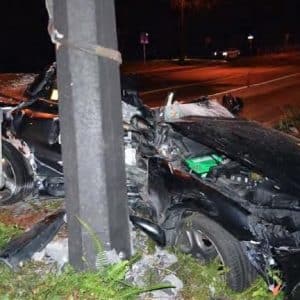
At the scene, there was confusion before there was clarity.
Cars slowing. People pulling over. That uneasy pause where no one knows what they’re seeing yet.
Emergency crews arrived fast. Faster than anyone expected.
Lights cutting through the gray. Voices sharp but controlled.
They moved with purpose — checking, securing, calling for more help.
They always do.
Still, not everything can be fixed.
Even with speed. Even with skill.
Two young lives were gone.
That sentence doesn’t land all at once.
It lands in waves.
For the family, the shock came first. The kind where your brain refuses to accept the words it’s hearing.
Then the silence.
Then the questions that don’t stop asking themselves.
Did we miss something?
Should we have waited?
What if we had taken another route?
Those questions don’t come from logic. They come from love.
Communities feel it too.
Especially when children are involved.
Something collective breaks open. People who didn’t know the family feel the weight anyway. Conversations lower. Small kindnesses multiply.
Candles appear. Messages. Quiet gestures meant to say we see you.
No one expects to be part of a tragedy. That’s why it spreads outward so quickly.
People begin replaying their own routines.
Their own drives.
Their own “normal” mornings.
Roads suddenly feel less neutral. Weather reports get checked twice. Silence fills car rides where music used to be.
Investigations start quietly in the background.
Officials look at conditions. At the vehicle. At the road itself.
Not to place blame — but to understand.
Understanding feels important, even when it doesn’t bring relief.
For the family, time behaves strangely.
Some moments stretch endlessly. Others vanish completely.
Grief doesn’t announce itself politely. It shows up in waves — in grocery aisles, in empty seats, in the sound of tires on wet pavement.
Children who survive carry questions they don’t always have words for.
Why did this happen?
Could it happen again?
Are we safe now?
Those questions linger longer than anyone expects.
People talk about healing like it’s a destination.
But it’s more like learning how to breathe differently.
Some days feel almost normal. That can feel wrong too.
Other days, everything hurts again without warning.
Communities try to help.
Meals arrive. Offers are made. Silence is respected.
Sometimes the best support is simply not rushing anyone through their pain.
Road safety conversations resurface, like they always do after moments like this.
Weather. Speed. Awareness. Preparation.
They matter.
But they don’t erase the randomness that makes accidents so terrifying.
Preparedness helps. Caution helps.
Still, not every variable is controllable.
That’s the part no one likes to admit.
Families start carrying emergency kits. Checking tires. Leaving earlier than planned.
Small changes born from big losses.
First responders carry it too.
Scenes like this don’t disappear when the shift ends. Especially when kids are involved.
They remember faces. Sounds. Stillness.
Support systems matter for them as much as for families.
As days pass, public attention fades. It always does.
Grief doesn’t.
It settles into quieter spaces.
Birthdays. Empty bedrooms. Unused car seats.
Moments where laughter used to fit easily.
And yet — life keeps moving.
That part feels unfair.
But it happens anyway.
People learn to move with the weight instead of without it.
Some find purpose in advocacy. Others in remembrance. Others just in getting through the day.
No one path looks the same.
What stays consistent is how fragile ordinary moments really are.
A drive. A plan. A day meant for joy.
All it takes is one unexpected shift.
And suddenly, nothing is ordinary anymore.
Somewhere, another family is packing for a trip tonight.
They don’t know this story.
They don’t need to.
But they will check the weather. Slow down. Hold hands a little tighter.
And hope — like everyone does — that the road stays kind.