Some stories don’t hit you all at once.
They unfold slowly, almost gently at first… until you realize you’ve stopped breathing somewhere along the way.
This is one of those stories.
It begins in a place most of us recognize — a normal life, a full car, plans for later that day. Nothing dramatic. Nothing fragile. Just a family moving through time, unaware of how thin that sense of safety really was.
It was an ordinary drive. The kind you forget five minutes later.
Traffic slowed. Cars stacked up. Engines idled.
And then, without warning, everything shattered.
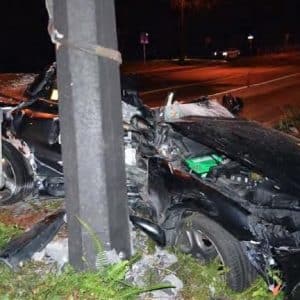
Metal screamed. Glass exploded. A force so violent it erased the shape of the vehicle entirely.
In the back seats were three small children. Too young to understand what was happening. Too young to protect themselves.
Emergency sirens came fast, but not fast enough to stop what had already begun.
The parents were injured. Disoriented. Rushed away in separate directions.
And the children… were scattered to different hospitals, as doctors fought a race that felt impossible from the start.
While their mother lay unconscious, two of the children slipped away.
She didn’t know yet.
She woke up to a world already missing pieces.
Her husband refused to accept that it was over. He pushed through the chaos, through his own shock, to get her to the last hospital — the one where their oldest child still clung to life.
She arrived in a wheelchair.
Barely able to stand.
Barely able to understand what she was being asked to do.
She leaned forward. Reached out. Whispered words no parent should ever have to say.
She told him his sisters were waiting.
Doctors removed the machines.
His heartbeat slowed under his father’s hand… and then stopped.
Three children. Gone. In one single day.
There is no word for that kind of silence.
The house they returned to still held toys. Shoes by the door. Beds that would never be slept in again.
Grief didn’t arrive politely. It tore through everything.
Eating felt pointless. Sleeping felt impossible. Breathing felt optional.
At their lowest, they made a promise to each other — not to heal, not to “move on,” but simply not to disappear.
They would stay. Together.
That promise became the only structure left standing.
Time passed in strange ways. Days blurred. Therapy sessions came and went. Faith flickered. Friends tried to help, even when they didn’t know how.
And somewhere deep in the grief, a question surfaced — quiet, almost guilty.
Could they still be parents?
Not to replace what was lost. Not to erase it. But to continue living in a way that honored those children.
The answer didn’t come easily.
The path wasn’t simple either. Medical barriers. Emotional ones. Long conversations that ended in tears more often than clarity.
Eventually, they chose to try.
Science stepped in where nature couldn’t.
And then came the news that stopped everyone cold.
Three embryos.
Two girls. One boy.
The same configuration.
The timing felt unreal. The weight of it almost unbearable.
Exactly one year after the day their world collapsed, three new lives entered it.
Joy arrived — but it didn’t come alone.
Happiness shared space with guilt. Laughter sat beside sorrow. Milestones triggered both celebration and grief.
Sometimes one parent would step into another room just to cry… then return smiling, because the kids deserved that version.
Motherhood remained at the center of everything for her. Friends would later say it was the first thing anyone noticed — her gentleness, her devotion, her quiet strength.
For a while, life found a rhythm again.
Not the old one. A new one. Fragile, but real.
They believed the worst was behind them.
Years passed.
The children grew. The family stayed mostly out of the spotlight, focused on ordinary moments that once felt impossible.
Then something subtle changed.
It started small. Dropped objects. Missteps. Bumping into furniture.
Easy to explain away.
Stress. Fatigue. Life.
But the changes didn’t stop.
Coordination slipped further. Movements slowed. And one day, there it was — a slight droop in her face that froze her husband in place.
This wasn’t normal.
Doctors’ offices replaced routines. Scans replaced small talk.
And then came the words no one is ever ready to hear.
Stage four brain cancer.
Aggressive. Fast-moving. Unforgiving.
The diagnosis felt cruel in a way that defied logic. As if life had circled back just to test them again.
Treatment began immediately. Surgery. Medications. Hope measured in weeks and small improvements.
Some days were better. Others stole ground back without warning.
Then came an infection. Another surgery. More weakness.
Still, there were moments — flashes of clarity, recognition, connection — that felt like gifts.
Eventually, she made a decision.
No more surgeries.
No more hospitals.
She wanted to be home.
With her family. Her dogs. Familiar walls instead of fluorescent lights.
The house transformed again — this time into a place of care.
Hospice came in quietly.
So did the reality of cost. Tens of thousands each month. A husband on unpaid leave. Children watching their mother change day by day.
The community noticed.
Strangers reached out. Donations poured in. Messages from people who had never met her but felt connected to her strength.
Her husband spoke honestly about the grief of watching someone you love slowly become someone different — not in spirit, but in ability.
“She’s still here,” he said. And that alone felt miraculous.
This story isn’t neat.
It doesn’t wrap itself in lessons or tidy hope.
It lingers.
Because some lives are defined not by what they lose… but by how much they continue to love anyway.
And somewhere inside this story, it still feels like something more is unfolding.